Sensor Chip
Sensor Chips for Bioprocess Monitoring
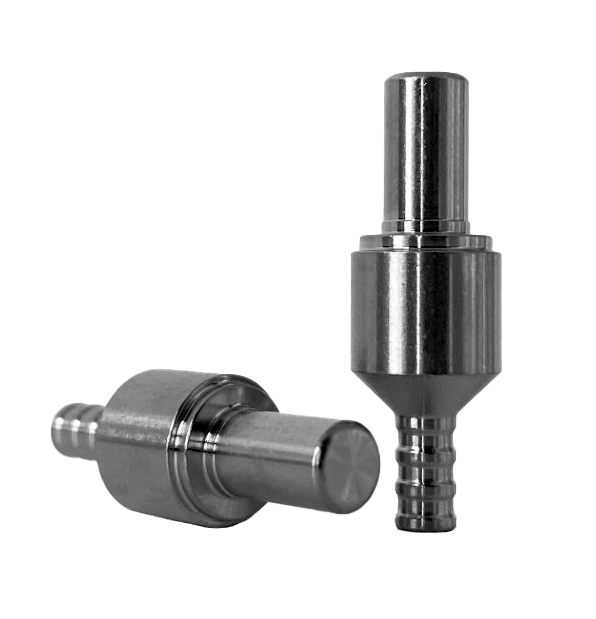
ArgusEye has pioneered a new generation of sensor chips for real-time bioprocess monitoring. Our robust, label-free sensor chips are at the heart of the Auga® platform, delivering continuous, reliable CPP and CQA data throughout biologics production, without the delays of traditional lab methods. Built on proprietary surface chemistry and years of scientific development, our biosensor chips set a new standard for speed, accuracy, and performance in bioprocessing.
Sensor Chip
Sensor Chips for Bioprocess Monitoring
ArgusEye has pioneered a new generation of sensor chips for real-time bioprocess monitoring. Our robust, label-free sensor chips are at the heart of the Auga® platform, delivering continuous, reliable CPP and CQA data throughout biologics production, without the delays of traditional lab methods. Built on proprietary surface chemistry and years of scientific development, our biosensor chips set a new standard for speed, accuracy, and performance in bioprocessing.
Sensor Chip
Sensor Chips for Bioprocess Monitoring
ArgusEye has pioneered a new generation of sensor chips for real-time bioprocess monitoring. Our robust, label-free sensor chips are at the heart of the Auga® platform, delivering continuous, reliable CPP and CQA data throughout biologics production, without the delays of traditional lab methods. Built on proprietary surface chemistry and years of scientific development, our biosensor chips set a new standard for speed, accuracy, and performance in bioprocessing.
What is a Sensor Chip?
A biosensor is built from a few key parts: a bioreceptor that recognizes the target analyte, a transducer that converts this recognition into a measurable signal, and electronics with a display that process and present the result. The sensor chip is where the sensing actually happens. It is the component in direct contact with the sample, carrying the bioreceptor used to detect the analyte.
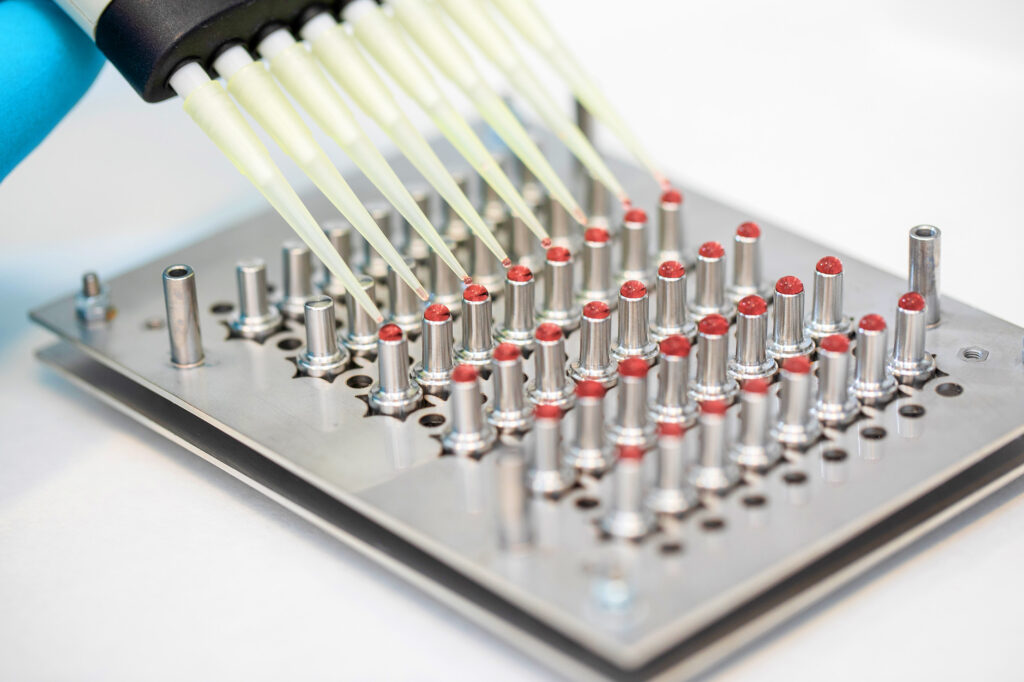
ArgusEye’s sensor chips are coated with gold nanoparticles and a specific ligand. Light reflected off the surface reveals how the surface chemistry has changed, and by varying the receptor or ligand on the chip, different analytes can be detected.
How Does the Technology Work?
ArgusEye’s biosensor technology is based on Localized Surface Plasmon Resonance (LSPR), a phenomenon that occurs when light interacts with metal nanoparticles on the sensor chip surface, causing their electrons to oscillate in resonance with the light. These oscillations are highly sensitive to changes in the local environment, so when the target analyte binds to the capture molecule on the chip, the resulting shift in refractive index is detected optically and translated into quantitative data in real time. No labels or sample preparation are needed, even in complex process media.
Sensor Chips for the Auga® Platform
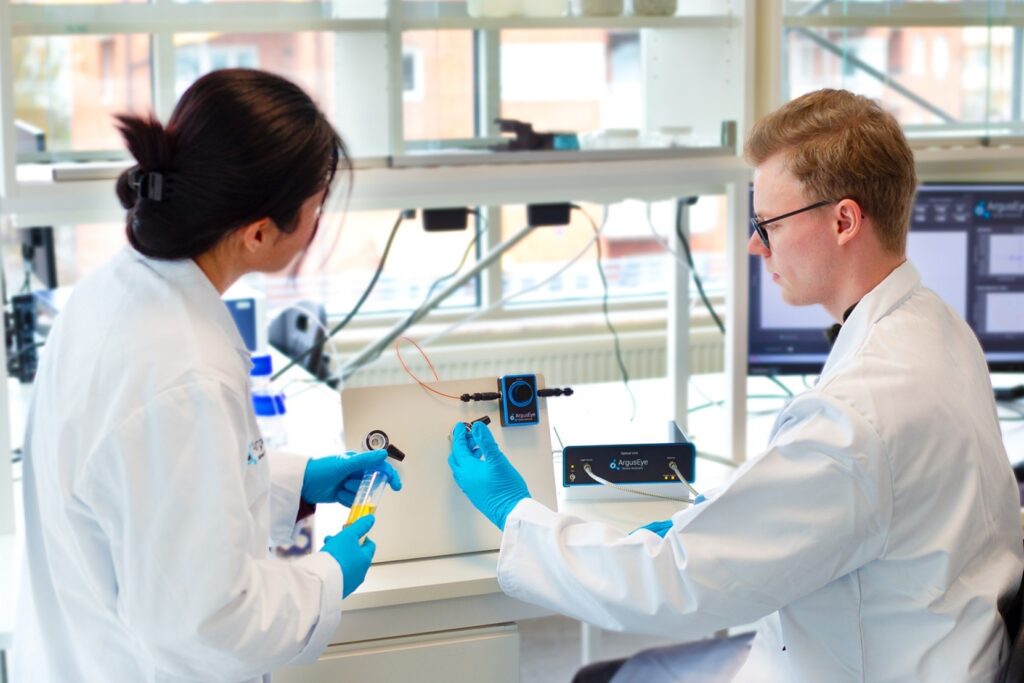
Within the Auga® platform, the sensor chip is functionalized with a capture molecule tailored to a specific analyte. By varying this capture molecule, the platform can be adapted to target different analytes, such as product titer, contaminants, aggregates, or quality markers.
By varying the capture molecule, the platform can be adapted to detect different analytes, such as contaminants or quality markers. Combined with data processing and analysis, the sensor can provide additional information on key product attributes, including product titer and aggregate levels.
Explore Our Sensor Chips
ArgusEye’s biosensor chips are currently available for IgG detection, supporting bioprocess monitoring at-line, on-line, and in-line. These chips use Protein A, Protein G, or Protein L as the ligand. Custom sensor chips can also be developed for specific analytes that require monitoring in a bioprocess, and additional sensor chip projects are in development for future launch.
Custom Sensor Chip
Explore Our Sensor Chips
ArgusEye’s biosensor chips are currently available for IgG detection, supporting bioprocess monitoring at-line, on-line, and in-line. These chips use Protein A, Protein G, or Protein L as the ligand. Custom sensor chips can also be developed for specific analytes that require monitoring in a bioprocess, and additional sensor chip projects are in development for future launch.
Explore Our Sensor Chips
ArgusEye’s biosensor chips are currently available for IgG detection, supporting bioprocess monitoring at-line, on-line, and in-line. These chips use Protein A, Protein G, or Protein L as the ligand. Custom sensor chips can also be developed for specific analytes that require monitoring in a bioprocess, and additional sensor chip projects are in development for future launch.
Protein A
Protein A
Protein G
Protein G
Protein L
Custom Sensor Chip

How Do Sensor Chips Enable Real-Time Monitoring?
ArgusEye’s biosensor chips unite binding, detection, and process insight in one continuous flow. As the target analyte binds to the capture molecule, the resulting shift in the LSPR signal is detected optically and converted into quantitative data, fully automated in under one second. This gives manufacturers real-time visibility into CPPs and CQAs throughout the bioprocess, without waiting for offline lab results.
The chip’s robust surface chemistry supports reliable operation in complex biological samples, with reproducibility comparable to HPLC-UV. It can be installed at any point in the bioprocess chain and reused across multiple runs, keeping real-time monitoring in place from development through manufacturing.
Choosing the Right Sensor Chip for Your Application
[Insert text]
Sensor Chip
Binding Site
Analyte Binding
Protein A
Fc region on IgG
Human IgG, primarily IgG1, IgG2 and IgG4. Limited binding to IgG3
Protein G
Fc region on IgG
IgG across multiple species and subclasses, including human IgG1–IgG4
Protein L
Light chain on antibody
Antibodies and antibody fragments with compatible light chains; binding is independent of the Fc region
Custom
Ligand-analyte dependent
Application-specific target, determined by the capture ligand. Can target selected proteins, contaminants, quality attributes, etc.